•
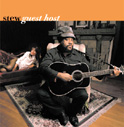
Stew: Guest Host

Contradictions are nothing new for Stew, and even the CD's title,
Guest Host, is an oxymoron. Stew admits that "guest" refers
to his living arrangements since the breakup of his marriage, but
says, "when someone comes to my show, it's like coming to my
party, and listening to someone's record is like stepping into their
sonic house. So I'm split--I don't have a place of my own, yetI'm
able to create musical worlds that people can inhabit in which I'm
the host."
TNP albums, namely Post-Minstrel Syndrome and Joys & Concerns,
"were supposed to sound like parties, carnivals." On the
more subdued Guest Host, he "didn't want it to feel like there
were a whole bunch of people around." He admits that at times,
"Joys" reveals the compositional impulses that have fueled
his solo career. The more intimate songs on "Joys" foreshadowed
Guest Host, and might never have been recorded by TNP if his solo
career had already been underway. "Now," he says confidently,
"I feel like I'm not gonna have that conflict any more."
But what about Guest Host's oddball boogie-down "She's Really
Daddy Feelgood," and the rousing album-closer "C'mon Everybody"?
"'Daddy Feelgood' started out as a slow dirge!" It was sped
it up for the album, but we can play both arrangements live. "And,"
he says, "'C'mon Everybody' is the absolute picture of restraint,
compared to the way TNP would've recorded it. The drummer's playing
with brushes, probably the most un-rock thing you could do."
Still, the word "rollicking" comes to mind.
Stew and TNP multi-instrumentalist Heidi Rodewald (who co-produced
with Stew) handled most of the playing & singing on Guest Host,
half of which was cut in New York with help from locals like Marty
Beller (film composer and occasional They Might Be Giants batteur)
and Chris Rael (of Telegraph labelmates Church of Betty, who arranged
the strings) while back in Venice, California, TNP family members
Lisa Jenio, Andy Sykora and Probyn Gregory (the latter also of Wondermints/Brian
Wilson tour band) lent their west coast wickedness to the proceedings.
Perhaps less wacky than TNP albums, Guest Host still runs the gamut
from the aforementioned booty-shakers to the gravity of "Cavity,"
opening the proceedings with a somber declaration, to the tongue-in-cheek
'30sish "Man in a Dress," to the morality tale with a Gilbert
& Sullivan-unplugged chorus called "Re-hab," to the
ultra-cool, sharp-tongued "Bijou."
"Bijou," by the way, is Stew's first commissioned composition:
Peter Case, noted for leading the Plimsouls as well as for his own
solo career, called one day to say the Getty Museum wanted to pay
a bunch of local songwriters to compose songs to tie in with a exhibition
of the works of noted photographer Brassai. Stew, who remarks that
Brassai was famous for his depictions of Parisian nightlife of his
era, was assigned a 1933 picture of a matron in an arty Montmartre
boite.
"Re-hab" was inspired by a real person but goes beyond that;
the unexpected upshot of the song dealing with society's curious ambivalence
about junkies if they are also rich or fabulous people. "As long
as they don't stink and don't borrow money, are not a nuisance, we
think they're OK, even fun to be around," in which case their
addiction can be glossed over.
With "Man in a Dress," Stew takes a tongue-in-cheek look
at women who go too far in expecting that Mr. Right's Yang will exactly
equal his Ying. As for the faux-Victrola sound, says Stew, "Sonically
we thought it would be a good palate-cleaner to have something that
sounds completely different in the middle of the record." But
musically it's a genuine tip-of-the-hat to "Noel Coward, Hoagy
Carmichael, '20s and '30s stuff...back when pop was alot more sophisticated."
Reviews
Tom Sinclair in ENTERTAINMENT WEEKLY's Best of 2000
issue names "Guest Host" the number one album of the year!
USA TODAY gives Guest Host three starts!
"After two wonderful albums with his cheekily named band the
Negro Problem, this brother from another planet (L.A. actually) delivers
a solo debut brimming with wry, joyously tuneful pop gems. Shall we
call this talented oddball the black Burt Bacharach? The inner city
Brian Wilson? The bastard offspring of Arthur Lee and Phoebe Snow?
Let's - and hope someone is listening.
A - Entertainment Weekly, Sept. 22, 2000
On his Solo debut, the leader of the idiosyncratic L.A.pop group the
Negro Problem mixes a '70s sensitive-guy thing with his band's Association,
Fifth Dimension and Zappa sensibilities. The delightful result is,
by turns, vulnerable and smart-alecky. Thanks to his sweet voice and
choice wordplay, the singer-songwriter pulls off poetic balladry,
12-step hilarity and swinging, organic grooves with equal panache.
Stew and he Negro Problem both play at Knitting Factory Hollywood
on Monday.- L.A.Times, September 9, 2000
"[three stars] Stew is Mark Stewart, a man large of spirit and
girth and the leader of L.A.'s bubbly psychedelic-pop combo The Negro
Problem. This is his first solo offering after two strong group efforts,
1997's sterling "Post-Minstrel Syndrome" and last year's
only slightly less wonderful "Joys & Concerns." (TNP's
multi-instrumentalist Heidi Rodewald plays a key role here, adding
backing vocals and tasteful instrumental touches.) The difference
between Stew in band mode and here is the absence of frenetic rhythms
and an approach to the studio that's more "Rubber Soul"
than "Magical Mystery Tour." As a result of the sparer settings,
his giddy lyricism comes into sharper focus, especially on tunes like
"Re-Hab" (a funny story-song about an L.A. poseur who dries
out more often than some people shower) and "Man In A Dress,"
the best throwaway ditty about transvestism since Syd Barrett's "Arnold
Layne." Jim DeRogatis, Chicago Sun-Times
On his Solo debut (due in stores Tuesday), the leader of the idiosyncratic
L.A.pop group the Negro Problem mixes a '70s sensitive-guy thing with
his band's Association, Fifth Dimension and Zappa sensibilities. The
delightful result is, by turns, vulnerable and smart-alecky. Thanks
to his sweet voice and choice wordplay, the singer-songwriter pulls
off poetic balladry, 12-step hilarity and swinging, organic grooves
with equal panache. Stew and he Negro Problem both play at Knitting
Factory Hollywood on Monday.- L.A.Times, September 9,
2000
Stew's solo project is a kaleidoscope of assorted pop melodies and
groovy sing alongs. With the help of co-TNPer Heidi Rodewald, the
quirky and thought provoking lyricist cooks up a delightful soup of
psychedelic pop tunes of varying degrees. He boats a funky boogie
in "She's Really Daddy Feelgood," eases the tempo with lullaby
rhythms on "Essence" and then fires up on "C'mon Everybody".
Hands down the most enjoyable track is his acoustic "Re-hab"-you'll
be stuck in it for days. Not to worry, though-Stew's a wonderful host.
HITS, August 11, 2000
With his solo debut, the Negro Problem's singer-songwriter Stew takes
pop in profound directions." - by Sara Scribnerm, New Times
LA
"Stew has distilled the past 30 years of Los Angeles pop songwriting
into a sweet and intoxicating elixir...awesome pipes that drip soul
without sounding forced...Baroque and broken. Great." (ePulse)
|
|


1.Cavity
2.She’s Really Daddy
Feelgood
3.Essence
4.Re-hab
5.Into me
6.Ordinary love
7.Man in a dress
8.The stepford lives
9.Bijou
10.Sister/mother
11.C’mon everybody
* House Made of Hope
* bonus track available on vinyl only
|