
 |
|
 |
|
 |
|
 |
|
 |
|
 |
|
 |
|
 |
|
 |
|
 |
|
 |
|
•
STEW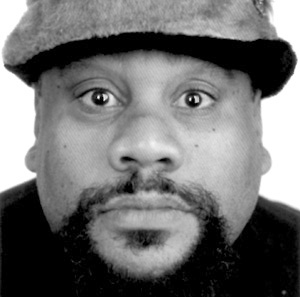 
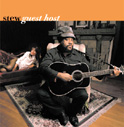
 Stew \'stu\ n: a heterogeneous mixture, says the Merriam Webster dictionary, a pretty good place to start defining Stew the man, musical artiste and women's hats fancier. Another handy meaning is "a state of suppressed agitation"...very familiar to Stew. But it's all just the tip of the iceberg that is the singer, songwriter, guitarist and leader of The Negro Problem, winner of critical notice from the likes of Spin, Entertainment Weekly, Rolling Stone and The New Republic, buzz-makers at both SXSW and NXNW, and perennial "best of" contenders on the L.A. scene. The band still exists, but the new CD is Stew's solo album. Hey, contradictions are nothing new for Stew, and even the CD's title, Guest Host, is an oxymoron. Stew admits that "guest" refers to his living arrangements since the breakup of his marriage, but says, "when someone comes to my show, it's like coming to my party, and listening to someone's record is like stepping into their sonic house. So I'm split--I don't have a place of my own, yetI'm able to create musical worlds that people can inhabit in which I'm the host." TNP albums, namely Post-Minstrel Syndrome and Joys & Concerns, "were supposed to sound like parties, carnivals." On the more subdued Guest Host, he "didn't want it to feel like there were a whole bunch of people around." He admits that at times, "Joys" reveals the compositional impulses that have fueled his solo career. The more intimate songs on "Joys" foreshadowed Guest Host, and might never have been recorded by TNP if his solo career had already been underway. "Now," he says confidently, "I feel like I'm not gonna have that conflict any more." Stew grew up in a predominantly African American Los Angeles neighborhood, "but," he declares, "people's minds weren't ghettoized." He played in bands from junior high on and "actually learned about hard-core white rock stuff--Zappa, Pink Floyd--from the most hard-core black musicians." Gobbling up the punk rock explosion as avidly as he had mainstream and progressive rock before it, he cut his first record (an EP) as a member of the Animated ("like a psychedelic Buzzcocks"). Following their breakup, he knew he wanted to do something weird, "only I didn't really know what 'weird' meant." So he tried New York's East Village on for size. He played simultaneously in an R&B/pop/rock group called the Uptown Atomics and a found-object all-percussion performance combo, the Attack Group, for which "I would literally play whatever piece of trash I found on the street on the way to the gig that was clean enough for me to carry into the club." After a while, Stew and some friends picked up and moved through Europe, settling in Berlin as the Wonderful Guise, where they were adopted by the anarchic avant art squatter community, which built them their own permanent performancespace. They enjoyed a fabulous couple of years of sex 'n' drugs 'n' performance art, incorporating two visual artists (one of which was cartoonist Tony Millionaire, who Stew met in Berlin) who "made environments and visuals, including these masks, out of foam and stuff. Sometimes the music had to be pre-taped, because with some of the masks, if you wore them you couldn't sing or play instruments." (The combo birdcage-toaster "hat" was Stew's favorite.) After a couple of years, paradise palled. Back in L.A., his alliance with drummer Charles Pagano ("a major influence") began a series of evolving bands: the free-jazz-cum-pop-melodies of imPOPisation, the mo re song-oriented Crazy Sound All Stars (later known briefly as the Popular Front), and finally TNP. After a number of singles--including a boxed set of three!--and appearances on the several local scene anthologies, the band issued its debut album, Post-Minstrel Syndrome, produced by Andrew Williams (of the Williams Brothers) with Stew. A mainstay of critics' 1997 Top Ten Albums lists, it was a treasure trove of diverse pop and rock elements--Love, XTC, the Fifth Dimension singing Jimmy Webb, perhaps a taste of Genesis, a bit of B-52's and a dollop of Dylan, with lyrics that tackled being a black man, an artist, an outsider, an other in '90s LA, sometimes bluntly, but more often than not from an angle all Stew's own. Post-PMS (the album, not the condition), enter ex-Wednesday Week bassist/backing vocalist Heidi Rodewald, and a stretch of serious rethinking and line-up shuffling. The recorded result, 1999's Joys & Concerns, at times possessed the kind of sheer pop exuberance that harked back to PMS. Yet Stew's offbeat sensibility was more finely focused, and the production (this time with Stew at the helm) was even better. It garnered the same lofty level of critical acclaim as PMS, and provoked lively debate among fans and critics alike as to which was the superior album. Further personnel shifts may have made it seem as though the band as an ongoing group of individuals was expiring, but Stew confirms it's still very much alive as a musical outlet that is parallel to--yet completely distinct from--his solo career. What does carry over from TNP is Stew's ambition to make music that people take to heart. Stew wants to make the kind of record that he's excited to receive, one that someone turns you on to and which proceeds to blow your mind. He's done it before with both TNP records, and Guest Host threatens to work the same kind of magic. |
 |
|